
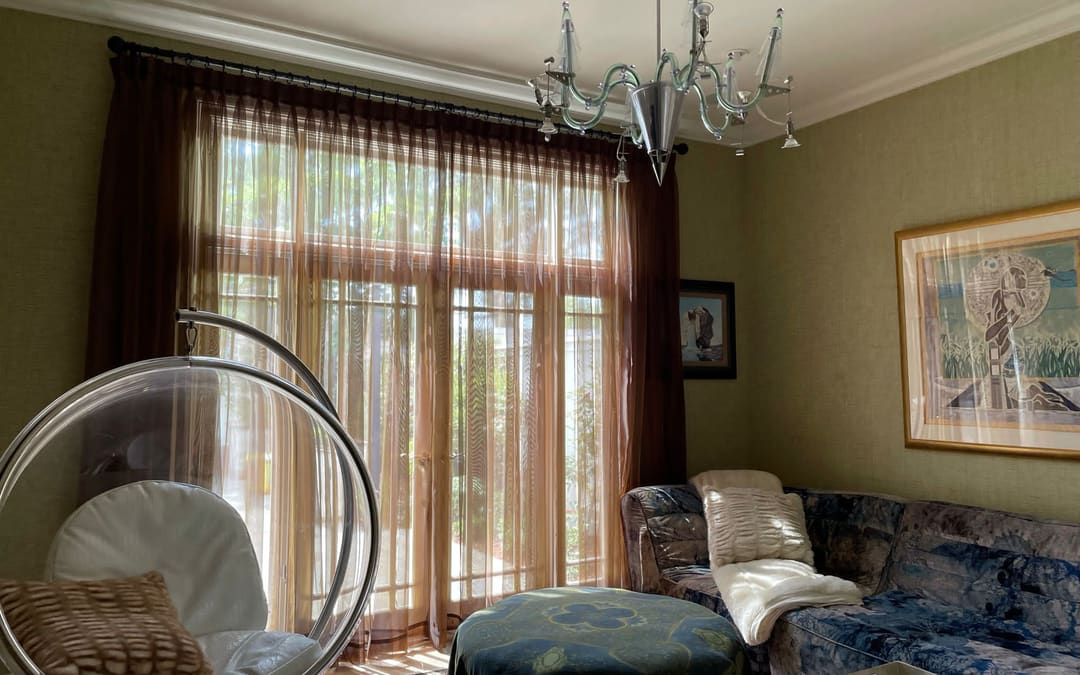
Ready-made curtains are cut to standard lengths and hung on standard rods. Custom draperies are built for one window, in one room, for the way you live in it. The difference shows in the fullness of the folds, the way the hem sits exactly at the floor, and how the panels stack clear of the glass when they are open. This is what we consider when we design and sew draperies for homes and businesses across Orange County.
Measuring: the part you cannot see but always feel
Every window is measured on site, usually three times across its width and height, because walls and floors are rarely perfectly square. We decide with you where the rod or track will sit (higher and wider than the glass makes a window look larger), how far the panels will stack back, and whether they will touch the floor, break on it by an inch, or puddle. Those decisions determine the finished length to the quarter inch and are the reason custom panels hang the way they do.
Fabric and fullness
A drapery panel uses two to two-and-a-half times the width it covers, which is what gives it those deep, even folds. Linen and linen blends drape softly and suit coastal homes in Laguna Beach and Corona del Mar; velvets add weight and quiet; sheers filter light while keeping the view. We carry sample books from the major design houses and can also work with fabric supplied by a designer.
Linings and interlinings
The lining is where draperies earn their keep:
- Standard lining protects the face fabric from sun and gives body to the folds.
- Blackout lining darkens a bedroom or media room completely and adds insulation.
- Thermal lining reduces heat gain on west-facing windows, a real benefit in inland cities such as Mission Viejo and Rancho Santa Margarita.
- Interlining, a soft flannel layer between face and lining, gives silk and fine fabrics the luxurious weight seen in hotel suites and formal rooms.
Pleat styles and headings
Pinch pleats, inverted pleats, goblet pleats, ripplefold and grommet headings each give a different rhythm to the folds and work with different hardware. Ripplefold on a ceiling track, for example, reads very clean in contemporary homes, while a French pleat on a decorative rod suits traditional interiors. We will show you samples of each heading at the consultation so you can see the folds in your own fabric.
Roman shades and other treatments
Draperies are not always the answer. Roman shades in a flat, relaxed or hobbled style suit kitchens and bathrooms; cornices and valances finish a window and hide hardware; motorized roller shades layered behind sheer panels give both privacy and softness. We make all of these in the same workroom.
Motorized draperies
Motorized tracks have become quiet, reliable and affordable enough for everyday use. They make sense for wide sliding doors, tall windows that are hard to reach, home theaters, and for anyone who wants the draperies to close themselves at sunset. We supply and install tracks that run on wall switches, remotes or home-automation systems, and we build the panels to the track's exact stacking dimensions.
How a drapery project works with us
We come to your home or business, measure every window, bring fabric and lining samples, and talk through headings and hardware. You receive a detailed estimate, and the panels are sewn in our San Juan Capistrano workroom and installed by us. Book the free on-site consultation or send us a message with photos of the windows to begin.