
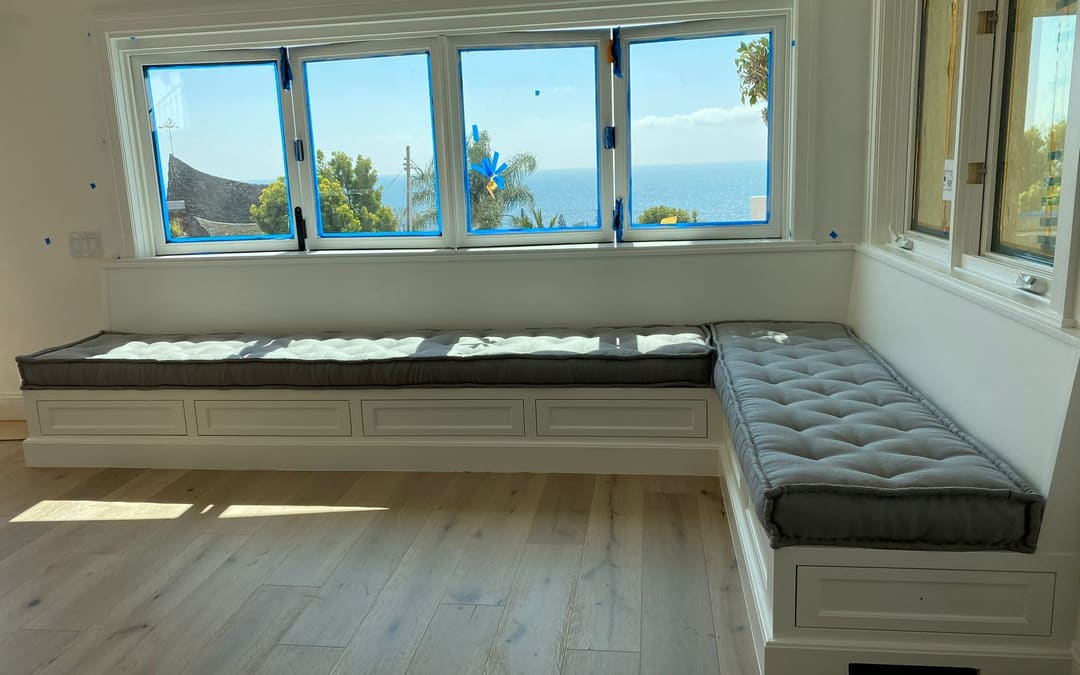
A window seat is often the favorite place in a house: morning coffee in the light, a book in the afternoon, the view at sunset. It is also one of the few pieces of upholstery you will never find on a showroom floor. There is no standard window seat, so there is no standard cushion.
Every window seat is one of a kind
A sofa is built to a catalog size and then placed in a room. A window seat is the opposite: the room comes first. Its length is set by the wall, its depth by the cabinetry, its shape by the window above it. One home has a straight bench under a single window; the next has an L that turns a corner, a bay with three or five angled sides, or a seat that wraps around a dining table.
Store-bought cushions come in a handful of rectangles. Lay one on a built-in and the problems show at once: a gap at the wall, an overhang at the front, a corner that does not meet, a seam that lands in the wrong place. On a piece that sits under a window and catches the eye from across the room, those gaps are the first thing anyone notices.
Walls are rarely square, and corners are rarely 90 degrees
On paper a window seat is a box. In a real house it almost never is. Walls lean a little, plaster bows, trim and baseboards step in and out, and an "L" corner may be a few degrees open or closed. Bay windows are angled by design, and each side can differ slightly from the next.
A cushion that is cut to a tape measure alone will follow the drawing, not the house. Getting a tight, clean fit means measuring every side, checking every angle, and noticing where the bench is an eighth of an inch longer at the back than at the front. That is why we come to you and measure on site: the numbers that matter are the ones taken in the room.
The details that decide the fit
Beyond length, depth and angle, an experienced workroom looks at:
- How the pieces meet. On an L-shaped seat, one cushion runs to the wall and the other butts against it, or the two meet on an angle. The choice changes how the corner looks and how each piece comes out for cleaning.
- Where the cushion splits. Long benches are usually made in sections so they can be lifted, turned and carried. Each joint is placed so it lines up with the cabinetry below, not in the middle of where someone sits.
- What is under the seat. Lift-up lids, drawers, heating vents and outlets all have to keep working with the cushion in place.
- Window and trim clearance. The finished cushion height has to clear the sill, the window hardware and any shades that come down to the seat.
- Comfort for the way it is used. A reading nook, a dining banquette and a seat for a crowd each call for a different foam and thickness.
- Pattern and fabric direction. Stripes and patterns should run straight and line up from section to section, and performance fabric is worth considering for a seat in full sun.
A window seat we made
The seat in the photo above sits under a wall of windows facing the ocean. It turns a corner into an L, with cabinet drawers and a heating vent below. Each side has its own tufted box cushion, made to the exact length and depth of the bench, so the two meet cleanly at the corner and nothing blocks the drawers or the vent. Nothing about it could have come off a shelf.
Why experience matters
Anyone can measure a rectangle. A window seat asks for more: reading the room, catching the angles that are not quite square, and knowing before the fabric is cut how the cushion will sit, close and wear. A mistake of a quarter inch shows on a built-in, and the fabric cannot be uncut.
We have been measuring, building and upholstering for homes across Orange County for nearly two decades, and window seats are among the pieces we enjoy most. If you have a window seat, a bay or a banquette waiting for the right cushion, book a consultation and we will come to you with fabric samples and take every measurement in the room.